A longitudinal cognitive companion

2lux

A little light, every day.

Two lights — one for the patient, one for the family caring for them.

A companion for children with rare epilepsy and cognitive differences — and a continuous record of what matters, between visits.

Follow the journey
Scroll

Most of what matters happens between appointments

A child with rare epilepsy sees a neurologist once or twice a year. Between those visits, families navigate almost entirely without data.

It is not a failure of care. There is simply no platform yet built around the individual patient — capturing their unique cognitive and neurological profile over time, in real life, not in a clinic.

Teacher
"He remembers less than before."
Father
"He is actually doing fine."
Mother
"Something feels different lately."
Neurologist
One standardised test score from 18 months ago — taken on a day that may not have been representative.
EEG
At most once a year. A single snapshot for a condition that changes daily.
Medication
Largely empirical — not from lack of care, but from a genuine absence of personal longitudinal data.

Same signal.
Two surfaces.

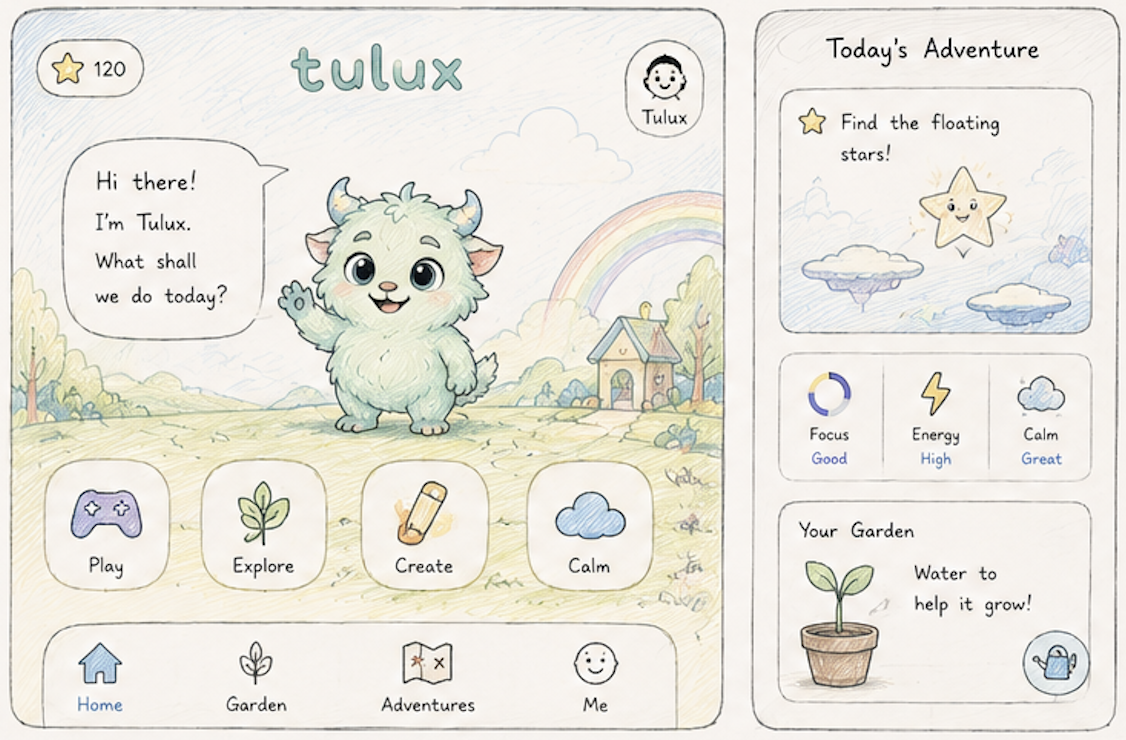
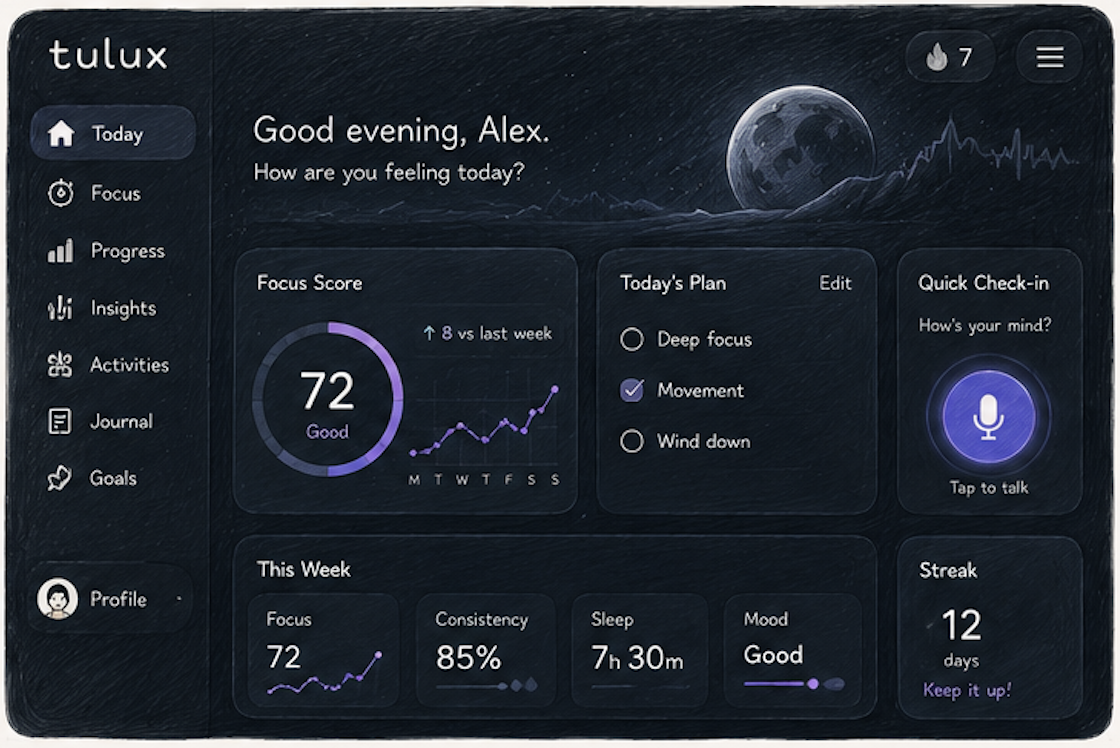
A six-year-old and a fifteen-year-old should not be looking at the same screen. The cognitive measurement underneath is identical — validated, WISC-aligned, longitudinal. The way it shows up is radically different.

For younger children · 6–10
A friendly companion that plays, talks, listens.
No reading required. Voice and visual. Measurement is the exhaust — never the foreground. Every patient's companion is uniquely theirs.
🐾
For teenagers · 11+
A personal space that respects their intelligence.
No childish UI. No reminders that they are sick. Just a tool they might actually want — themed around what they love.
SAME MEASUREMENT UNDERNEATH
01
Personalised Companion
Adapts language and difficulty to each patient's cognitive level. Voice-first, no reading required.
02
Cognitive Games
WISC-V aligned across working memory, processing speed, executive function, and more.
03
Wearable Data
Passive HRV, sleep, and activity from a smartwatch. Zero extra effort from the patient.
04
Family Dashboard
Longitudinal cognitive trends, sleep, and medication events on one timeline.
05
Together
Play alongside a family member or friend. A solo experience becomes something shared.

A record you own.
A picture that holds steady.

Twelve weeks instead of one afternoon. A clear baseline for this patient — not a comparison against averages that may never have applied to them.

Working Memory
100.6
↑ +5.6 vs baseline
Processing Speed
94.4
↑ +6.4 vs baseline
Visual-Spatial
106.3
↑ +4.3 vs baseline
Fluid Reasoning
95.9
↑ +3.9 vs baseline
KCNB1 · 8 years · Illustrative
Working Memory
ILLUSTRATIVE SYNTHETIC DATA · NOT A REAL PATIENT

Rare epilepsy first.
Where the gap is sharpest.

The data vacuum is most acute in rare genetic epilepsies. We start there — because the need is sharpest, and a small, focused product can make an immediate difference. The architecture generalises.

KCNB1 KCNQ2 SCN8A SCN1A Dravet syndrome Lennox-Gastaut PCDH19 Childhood epilepsy broadly
First-hand experience
Built by a father of a KCNB1 child, who went back to study computational neuroscience because he couldn't just sit still. Not designed from the outside looking in.
Community first
Co-designed with rare epilepsy families from day one. Not tested on them — built with them. The community shapes what gets built.
Built in Europe
2lux is built and hosted entirely in Europe. Patient data — especially data this sensitive — stays where it belongs.

Building slowly.
Learning first.

No dates. No promises. Stage-gated by what we learn and what funds. Every step is shaped by conversations with families — not by a product roadmap written in a vacuum.

Now
Listening
Conversations with families across the rare epilepsy community and with clinicians who treat these conditions. Refining the concept against real experience. Applying for funding in parallel.
Next
Focused PoC
One cognitive game. One companion character. One family dashboard. Built and tested with 2–3 families over 12 weeks. Reviewed with a clinical advisor.
Soon
Wider Pilot
A broader pilot across the rare epilepsy community. Expanded WISC domain coverage, deeper wearable integration. Continuous co-design throughout.

No dates yet · Stage-gated by what we learn and what funds